
A man injected her with HIV. A YouTube video blamed her and drove her to death
T
The News MinuteSource Link
about 8 hours ago
Kandikonda Ramani was the daughter of flower sellers. At 24, she was on track to getting a Master’s degree in Chemistry, hoping to land a government job. Perhaps a college lectureship. She would have been the first in her family to graduate and draw a salaried income. That was the future she and her family had always pictured, living in a one-room-and-kitchen flat in a government housing colony on the outskirts of Hyderabad.
But on April 10, Ramani ended her life. Exactly a month after her ex-boyfriend, Manohar, drew his own blood with a syringe and injected Ramani in her forearm. He had HIV.
His infection was the reason Ramani’s parents refused to let them marry. Manohar thought if she was also infected with the virus, her parents would be left with no alternative but to let them marry, the police said after arresting him for attempted murder. Manohar is also Ramani’s second cousin.
While Ramani was under treatment and dealing with the trauma from Manohar’s attack, a YouTube video pushed her to breaking point. Vedhaan Media, a sensationalist YouTube channel with almost a million subscribers, put out an interview with Manohar’s mother Rama, his brother Venu, and an advocate named Shiva Kumar. In the interview, they purportedly claimed that Manohar was innocent, that the horrific plan of injecting his blood was actually Ramani’s idea. They insinuated that the two of them had been sexually involved, as if that somehow mitigated Manohar’s actions. The video is no longer available online.
Ramani squarely blamed this interview for her suicide. In a video she recorded minutes before her death, she said, “They have ruined my life by putting it out on social media for lakhs of people to see. They ruined my character. I don’t want to live without respect.” She broke down before every sentence.
Since she was 19, Ramani had been dealing with one distressing problem after another, all while handling her studies and working part-time teaching jobs.
First, she found out almost eight months into dating Manohar that he had hidden his HIV infection from her. He and his family somehow persuaded her that it wasn’t a big deal.
Last year, after they had been dating for around four years, she told her parents about their relationship. Her parents convinced her that HIV wasn’t a trivial condition, and arranged her marriage with someone else.
But Manohar and his family, along with Ramani’s grandmother, tried to persuade her that she was making the wrong decision. When her parents looked for guidance from religious leaders, one pastor told them that having faith could help manage HIV.
In her suicide note, Ramani kept apologising to her parents over and over. “Mummy, forgive me. You worked so hard to give me an education, but I ruined my life. I shouldn’t have loved him. You had so much trust and hope in me, and I ruined it all. Sorry, mummy. If there’s another life, I wish to be born to you again.”
When TNM visited her home two weeks after her death, her grief-stricken parents were still struggling to make sense of everything that has happened to them in the past few months.
Every thought was laced with doubt and regret – what if they had learned of their daughter’s relationship sooner, what if Manohar had tried to elope with her instead, what if she never saw the awful YouTube video, what if she had just stopped checking her phone, what if she had put out her own video debunking the accusations, what if they had moved to a different house which didn’t constantly remind her of Manohar’s assault, what if they had kept closer watch on her the day she died…
Ramani was already guilted and conflicted by some of her family elders’ ignorance and misguidance, when Manohar committed the reckless, vicious attack. She was heartbroken, scared, and struggling to hold on to hope, when the YouTube channel tried to capitalise on the shock value of the violence inflicted on her. That became the last straw for her. Our story tries to piece together the series of harsh events that ended in Ramani’s death.
An ill-fated relationship
Ramani’s parents, Chiranjeevi and Maheshwari, sell flowers on a pushcart. The couple moved to Annojiguda in Medchal-Malkajgiri district from their native village near Mulugu many years ago. They had been living in the government housing colony since Ramani started going to school. They belong to the Kummari (BC) community.
Manohar’s mother Rama moved to the same colony with her two sons, after her husband died from AIDS in 2008. Rama is Chiranjeevi’s cousin – Chiranjeevi’s mother Venkatamma and Rama’s mother Upendramma are sisters. Rama also sells flowers for a living.
“We had heard rumours that Manohar’s father had died from AIDS, but we never felt the need to ask them about it. We would see them occasionally during family gatherings, but we weren’t particularly close,” Chiranjeevi said.
Ramani was a shy child who always did well in school, according to her mother. Neither Maheshwari nor Chiranjeevi went to college. But Ramani was about to complete her MSc. Her younger sister is in her final year of B Com and her younger brother has just started BTech. The couple had hopes that all three of their children would move into a higher socio-economic class with office jobs.
In Ramani’s own words in her suicide note, “Since childhood, I never talked much to anyone. Especially not to boys. My goal was always to study well, get a government job, and be well settled in life.”
Referring to Manohar with disdain, she said she never spoke to him much when they were kids, though they were of the same age. He started talking to her frequently after she began college, mostly over text messages.
He asked her out in her second year of college, when she was around 19. She rejected him at first, even blocked his number. But he was persistent and eventually they started dating.
“The only reason I agreed to go out with him is because he doesn’t drink alcohol,” she wrote.
Manohar had only studied up to Class 12. Around eight to nine months into their relationship, he applied for a police constable job. He underwent medical tests as part of the recruitment process, which showed that he was HIV positive.
“The twist is that he always knew… since childhood he knew that he had HIV. He deliberately ruined my life,” Ramani wrote.
But at the time, she said she didn’t understand the seriousness or consequences of HIV.
HIV has become a manageable health condition over the years, with antiretroviral therapy (ART) able to suppress the virus levels and lower the risk of developing AIDS. But there is still no cure for HIV.
Ramani said that Manohar persuaded her not to break up with him, in the name of love. He told her he couldn’t live without her. He claimed he had lived with HIV for over 20 years without medication, and that she would also be alright even if she was infected.
“He said HIV wasn’t a serious condition, otherwise he would’ve died years ago. I thought he sounded reasonable, that he seemed to be doing well without medication and was quite active too,” she said.
They got back together.
She completed her undergraduate studies and started pursuing MSc Chemistry at a college in Begumpet, Hyderabad. She was also working part-time as a teacher at a private school near her home and taught tuition classes at home for kids from the neighbourhood.
In June 2025, during a cousin’s wedding, her parents said it was time for Ramani also to get married. She told them about Manohar. When their families met, Ramani’s father brought up the topic of Manohar’s father’s death from AIDS.
“We asked both Manohar and Ramani to get an HIV test, to be safe. We thought they might be offended if we only asked the boy to get tested,” Ramani’s mother Maheshwari said.
Manohar tested positive, as they had feared. Ramani tested negative.
How persuasion turned into violence
“We told Manohar and his family that the marriage wasn’t a good idea, that we can’t be reckless with our daughter’s health, that it would affect their children too. We even told him that we could help him find a woman who already has HIV through such dedicated matrimonial services. They seemed to accept our decision. They didn’t try to argue with us. We didn’t foresee any tension,” Chiranjeevi said.
But he didn’t know that during this time that his own mother, Venkatamma, was advising Manohar to elope with Ramani.
Along with her sister Upendramma, Venkatamma allegedly “instigated Manohar” and insulted Ramani, “adding to her mental distress,” Maheshwari said in her complaint to the police after her daughter’s death.
Manohar had told Ramani that Venkatamma had advised them to get married in a church or temple and stay with relatives for a few months. “He said even your grandmother supports us,” Ramani said in her letter, explaining how Manohar remained persuasive.
On the other hand, her parents, uncle, aunt, cousin, and even pastor, as per her suicide note, told her that an HIV infection cannot be overlooked. “I became convinced that their advice was well-intentioned, and that HIV is a serious condition,” Ramani said.
She then completely cut off Manohar.
In February this year, Ramani agreed to marry a man her parents chose for her.
But within a week, her father’s younger brother passed away. The family was in mourning, and Ramani’s engagement was postponed indefinitely. Manohar and Ramani’s families, who weren’t in contact since the wedding proposal was rejected, were now on cordial terms again.
On March 8, Ramani said Manohar called her. He asked her whom she planned to marry. She told him she would marry the man her parents had chosen, not him.
Three days later, on March 11, he turned up at her house. Ramani was asleep on a bed a few feet from the main door. Manohar had already asked her younger brother to leave the house for a while.
“I was asleep when he came in and locked the door. At first, I thought it was my brother. He came towards me and said, how can you marry someone else? He forcefully held my hand and injected his blood. I screamed in fear, but no one heard,” said Ramani.
In her video statement filmed before her death, she said she initially didn’t tell her family about the injection. She was already dejected and having suicidal thoughts. “I had decided not to marry anyone but to end my life. That’s why I didn’t tell anyone,” she said.
She did contact Manohar’s mother Rama and brother Venu, but they told her it wasn’t a big deal and she would be alright.
“His brother messaged me the next day (March 12) on Instagram. He urged me not to go to the hospital, saying it would become a police case. He said nothing would happen to me, that I should just take some tablets for my fever,” Ramani said.
Her parents noticed she was unwell. They took her to a private clinic near their house, where the doctor grilled her about the bruise on her forearm. She came clean.
“The doctor told us she needed medical attention immediately. He said if we inform the police, they would ensure proper treatment at a good public hospital,” said Chiranjeevi. So he went and filed a police complaint on March 13. Police arrested Manohar the same day. He has since stayed in judicial remand.
They took Ramani to Gandhi Hospital in Hyderabad, one of the best public hospitals in the state. She was treated there for a couple of days and prescribed some antiviral drugs.
The doctors told her that it would take a couple of months to assess whether she had been infected with HIV. They told her the virus could be suppressed with antiviral drugs, that even if she did get HIV, it could be managed with lifelong medication. “When they learned she was studying chemistry, some of the medical staff even encouraged her to apply for a job at the hospital after completing her Master’s,” her mother said.
Her next hospital visit was due in just a couple of days when Ramani ended her life, her father said, picking up a strip of her unfinished tablets.
The YouTube video that drove Ramani to end her life
While they were focused on their daughter’s treatment, Chiranjeevi and Maheshwari said that Manohar’s mother and brother pleaded with them to withdraw the police complaint.
“It was too late by then. They had learned of the incident right after it happened. If they had helped her get medical care immediately, things might have turned out differently, but they tried to silence her to protect their boy,” Chiranjeevi said. Now, they could only think of protecting their daughter.
Ramani returned home from the hospital in a couple of days. Her parents started looking for a house to rent, to get her out of the space that held agonising memories.
But just then, within five days of Manohar’s arrest, his family gave an interview to Vedhaan Media. The video was taken down immediately after Ramani’s death.
But Ramani’s video statement shows how much it troubled her.
Rama, Venu, and the advocate Shiva Kumar claimed in the interview that Manohar was innocent. Ramani’s parents, who saw the video, said Manohar’s family tried to paint Ramani as a devious woman who herself came up with the idea of injecting his blood into her and that he only did it because she encouraged him to.
In their attempts to portray Manohar as innocent and Ramani as deceitful, they also claimed that the two of them had been sexually involved.
“They mentioned physical intimacy and spoke ill of my character. If we had been physically intimate, shouldn’t I be HIV positive too?” Ramani asked between sobs.
“For no mistake of mine, they said crazy things about me. Those things are constantly running in my mind. I can’t do this. I can’t live without respect,” she said.
She stressed that the main reason for her death was Venu’s words, who seemed to have claimed that she had agreed to be injected with Manohar’s blood.
“We didn’t have any ‘mutual understanding’ [to inject his blood]. [Manohar] did it by force. Vedhaan Media, without finding out the truth, you [carried accusations] about a girl. Now people are speaking ill of me. I’m unable to tolerate it. That’s why I am dying by suicide. Bye,” she said, ending her video.
Why would Vedhaan Media post an interview with such absurd claims, is a question that haunts Maheshwari. “The channel could’ve talked to us and shared our version too. Or they could have cut out the portions with sensitive claims about a young woman. They did neither,” she said.
That’s because such interviews were Vedhaan’s mainstay. The channel, run by Vedhaan who also does all the interviews, thrives on sensationalism. It has 9,53,000 subscribers, with some of its videos clocking over a million views.
Vedhaan is a self-proclaimed Jana Sena Party supporter and a devotee of Ram and Hanuman. But beyond any communal or gender politics, what his channel values is shock, drama, exaggeration, and absurdity.
In March, he covered the murder of 19-year-old YouTuber Vaishnavi by her husband Haribabu. “If you want to protect women in your home, you must raise your voice for Vaishnavi,” he shouts into the camera in one video.
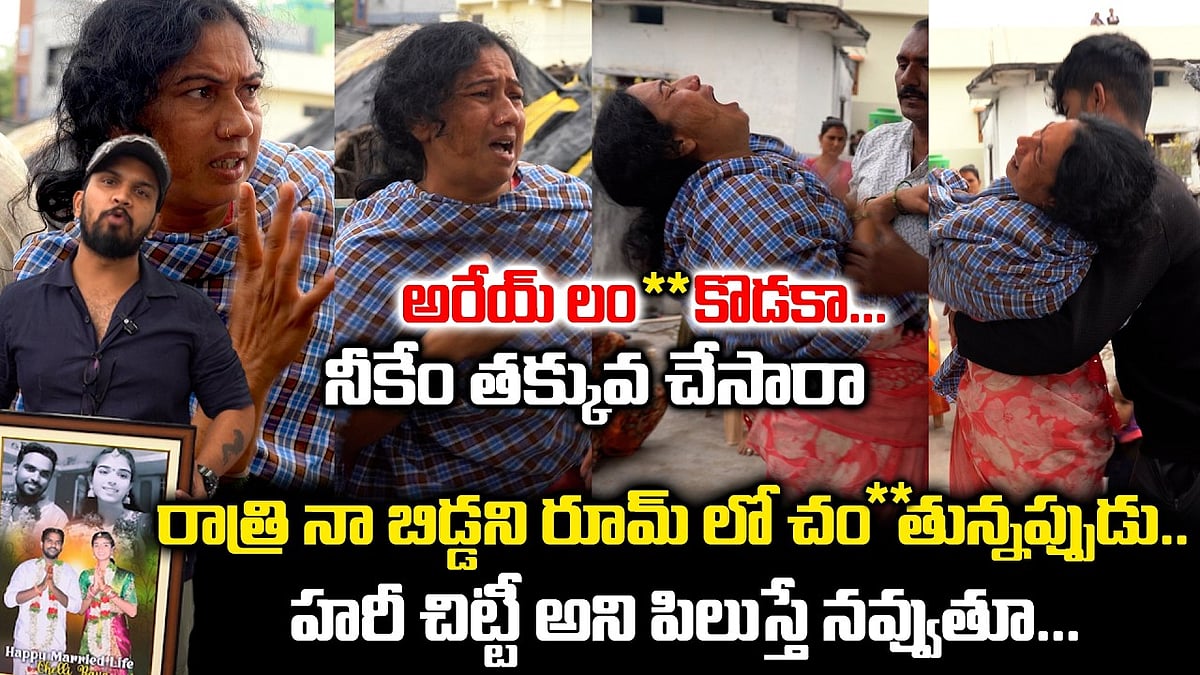
In another video, he claims to carry out a ‘sting operation’ on a man accused of sexually assaulting his nine-year-old daughter. The man purportedly confesses to his crime on camera, and Vedhaan abuses and slaps him while posturing as a defender of children and women.
He often takes on a confrontational, aggressive tone with abusive language.
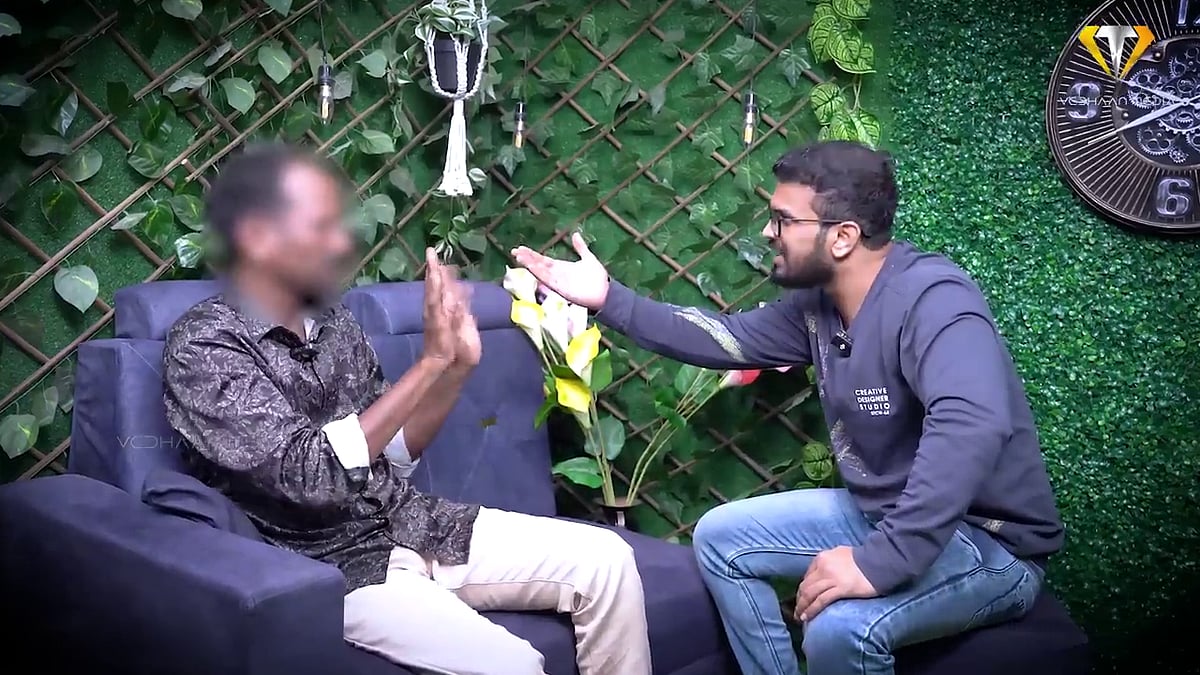
The channel also appears to have a pattern of conducting contrarian interviews with people accused in criminal cases. In these videos, Vedhaan assumes a gentler tone and the air of someone ‘investigating’ the less popular side of the story.
For instance, Vedhaan interviewed a married couple accused of ‘honey trapping’ several men, with the husband allegedly filming them having sex with his wife and later blackmailing them. He also interviewed a content creator accused of abetting the suicide of a woman, allegedly following an extramarital affair with her husband. In both cases, he gave the accused a platform to profess their innocence, contrary to the coverage of nearly all other mainstream and social media channels.
Vedhaan publishing an interview with Manohar’s family, without challenging their claims, fits into this history of salacious, scandalous coverage of crime stories. The YouTuber is absconding, the police said. The channel hasn’t posted any new content since Ramani’s death.
Ramani’s mother said she became obsessed with the video of Manohar's family's interview. “We asked her to keep away from her phone. She did it for a couple of days but kept going back to it. She kept checking the comments. She was disappointed that even people who knew her in person were agreeing with the video and posting negative comments against her,” she said.
Ramani badly wanted to regain control over her own narrative, according to her mother. “She wanted to put out a video with her side of the story, an answer to their accusations,” Maheshwari said. But the police and others advised her against revealing her face to the world, worried it would bring more negative attention and cause her more distress.
In her note, Ramani specified that Vedhaan Media, Venu, Rama, and eight accounts that had commented on the video were responsible for her death.
Police have booked all of them for abetment of suicide, along with the grandmothers, Venkatamma and Upendramma, and the advocate.
“We have arrested Manohar, Rama, Venu, and Upendramma so far. Vedhaan, who runs Vedhaan Media, and the others are absconding. We have written to YouTube for details of the accounts,” Pocharam IT Corridor Inspector of Police K Kanakaiah Goud told TNM.
Never-ending apologies and regrets
Maheshwari is still in disbelief that Manohar injected her daughter with his blood. “What a cruel thing to do. How does one even think of something like that? We now wish he had forced her to elope with him instead, like their grandmother suggested. At least then my daughter would’ve lived,” she said.
Chiranjeevi can’t believe his own mother tried to guilt-trip his daughter for refusing to marry Manohar.
“I don’t know why [Venkatamma] was so adamant that they should get married. Maybe she felt bad for Manohar’s HIV condition and thought he wouldn’t find someone better than Ramani. Maybe her sister [Upendramma] talked her into it. Maybe it was ignorance. But she was very flippant about the HIV,” Maheshwari said, rueing that her mother-in-law didn’t protect her daughter.
At a church in Mehdipatnam their family briefly attended along with Manohar’s, the pastor too allegedly dismissed the HIV, saying it could be managed with medication and prayer. Maheshwari has stopped going to that church since then. She wondered if Manohar would’ve left her daughter alone if people like that pastor and Venkatamma hadn’t acted so unconcerned about HIV, thereby perhaps emboldening him.
When Chiranjeevi and Maheswari were out all day selling flowers, the three siblings would stay home, Ramani looking after the younger ones.
In her final days, Ramani’s sister was always by her side, through her treatment at the hospital and at home. The day she died, Ramani said she was going to a store but went to her grandmother Venkatamma’s house instead, where she ended her life.
The parents wonder how things might have been different if Ramani hadn’t been left alone on the day Manohar attacked her. Or the day she ended her life.
Ramani asked her parents for forgiveness on her siblings’ behalf too.
“Chinni, Munna, take care of mom and dad. Mom and dad, forgive them,” she wrote in her note.
Ramani left them with many apologies. And her family is left with many regrets. “We feel helpless that we could not protect her. But we had to work, we couldn’t always be around. We wanted them to be able to go to college,” Maheshwari said.
A garlanded photograph of Ramani hangs on a wall of the house. Her parents said they don’t mind if the world sees her now. “Maybe if she had replied to that video with one of her own, she would have lived,” Maheshwari said, more certain now that her daughter didn’t have anything to feel ashamed of.
If you are aware of anyone facing mental health issues or feeling suicidal, please provide help. Here are some helpline numbers of suicide prevention organisations that can offer emotional support to individuals and families.
Tamil Nadu:
State health department's suicide helpline: 104
Sneha Suicide Prevention Centre - 044-24640050 (listed as the sole suicide prevention helpline in Tamil Nadu)
Andhra Pradesh:
Life Suicide Prevention: 78930 78930
Roshni: 9166202000, 9127848584
Karnataka:
Sahai (24-hour): 080 65000111, 080 65000222
Kerala:
Maithri: 0484 2540530
Chaithram: 0484 2361161
Both are 24-hour helpline numbers.
Telangana:
State government's suicide prevention (tollfree): 104
Roshni: 040 66202000, 6620200
SEVA: 09441778290, 040 27504682 (between 9 am and 7 pm)
Aasara offers support to individuals and families during an emotional crisis, for those dealing with mental health issues and suicidal ideation, and to those undergoing trauma after the suicide of a loved one.
24x7 Helpline: 9820466726
Click here for working helplines across India.