
In the summer of 2020, India had no shortage of stories.
The country was emerging from what was described as the world’s harshest lockdown, one that had triggered the largest internal migration since Partition and, it later emerged, had been enforced without consultation within the government. The economy was about to record its first recession in four decades, driven not so much by the pandemic as by the lockdown itself, which contracted the economy by nearly 24 percent in that quarter. Petrol and diesel prices were hiked every single day between June 7 and June 21.
On June 14, Bollywood actor Sushant Singh Rajput died by suicide following a bout of depression.
Two days later, on June 16, 20 soldiers were killed during clashes with Chinese forces in Ladakh, the first combat deaths on that border in at least 45 years.
So what did two of India’s most-watched English news channels — Times Now, operated by Bennett Coleman and Co Ltd, and Republic TV, independently set up by anchor Arnab Goswami with initial funding from a former BJP minister — choose to focus their primetime debates on across May, June and July?
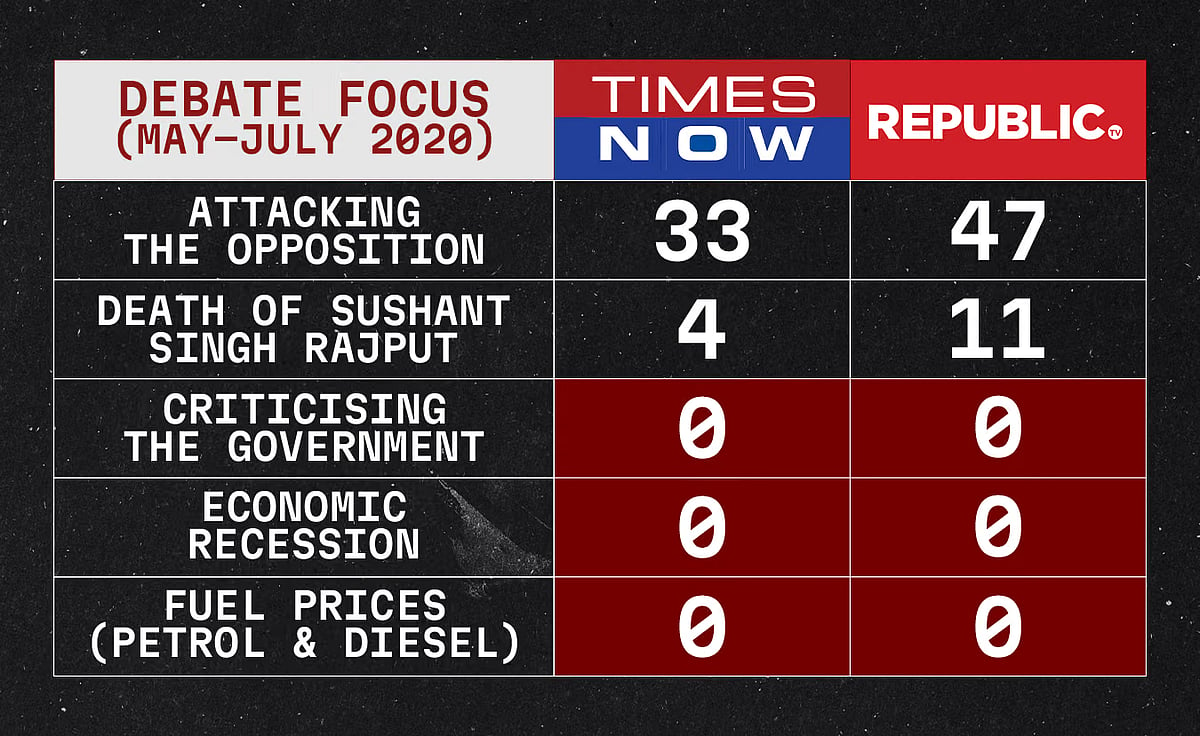
This is what ‘Godi media’ looks like in practice.
The overall tone and tenor of these primetime debates can be captured by the headlines running across May, June, and July of 2020:
Times Now:
“Congress accuses NDA of exploiting migrants for train fares. Is Party faking fear?”
“Rahul Gandhi lauds pictures of 'Azad'. Sacrifice of braves insulted?”
“Handwara martyrs avenged. Dreaded terrorist killed but backers attack our braves?”
“PoK on India weather map. Safest in PM Modi’s hands?”
“India united to fight pandemic but Lutyens spreads 'Communal virus'?”
“PM-CMs crucial meet to put lifeline back on track but why Opposition red flags?”
“PM Modi’s motto to power self-reliance but Congress sees 'No real relief'?”
Republic TV:
“Congress and Lobby politicise Aurangabad tragedy”
“Rahul Gandhi aide to Nirav Modi’s rescue?”
“Congress in trillion-dollar controversy”
“Are states blocking migrant movement?”
“Mystery over Congress’ China strategy”
“Congress plays petty namecalling over 20 lakh crore package”
“India leads global fight to expose China”
“Migrants need trains, not lies and propaganda – Congress dumps migrants”
“Proof demolishes Congress’ '1000 buses' claim”
“Priyanka Gandhi’s bus sham falls apart, Congress loses plot”
This pattern does not exist in isolation.
Evidence of coordination between what the government wanted put out and what the channels broadcast came on June 19, 2020, when former NDTV correspondent Arvind Gunasekar tweeted the text of a note the government had circulated to journalists as ‘talking points’ after an all-party meeting on the Chinese intrusion — the same meeting in which Modi claimed there had been no intrusion by China.
Gunasekar said: “This was circulated to media from PMO as ‘Govt Sources’ even when the meeting was underway.”
The talking points the Modi government wanted the media to focus on included:
India stands solidly behind [the] PM. Most leaders express their confidence in [the] way [the] Modi Government has handled the situation.
Congress efforts to create wedges trashed by KCR, Naveen, Sikkim Kranti Morcha.
The channels obeyed. Times Now’s primetime debate a few hours later was headlined: “All parties unite behind India but Sonia Gandhi won’t slam China?” The next night: “Congress disarmed our braves first and now supports ‘tukde’ ethos?” and “PM Modi’s strong message over India–China LAC standoff decoded”.
Republic TV’s main debates that evening were headlined: “Unarmed with fact, Congress insults army”; “Is there a ‘special relation’ between Congress and China?” and “People’s movement against China gets bigger”. The next day: “PM sends a powerful message to the nation on LAC” and “Cong traitor caught: ‘Break India’ forces reveal their agenda”.
However, not all channels followed the PMO’s line.
NDTV India’s Ravish Kumar headlined his debate “Desh ke liye jaan dene wale jawanon ko shradhanjali” (Tribute to India's martyrs).
The next day: “Pulwama ke samay jaisi parampara jari reh sakti thi” (Pulwama’s tradition could have been continued) — a reference to how differently the State had treated the 20 Indian soldiers killed by China in Galwan and the 40 CRPF personnel killed in the Pulwama suicide attack in February 2019, whose coffins were received by Prime Minister Narendra Modi.
Ravish Kumar would leave NDTV after Prannoy Roy was forced out and Gautam Adani took over, about which more later.
This total capitulation across the industry raises a question that is less often asked: why does it persist when it appears to have done nothing for the bottom lines of the companies that produce it? This analysis attempts an answer.
What the numbers show is striking. Corporate Indian news media ended the decade from 2014 to 2024 with most of its major companies, including Bennett Coleman, HT Media, and NDTV, stagnant or in the red.
And yet, through this period of economic decline, the same companies chose to act as enthusiastic defenders of the government presiding over their stagnation.
Most people assume the answer is money. This piece tests that assumption.
Understanding why requires looking at how Indian media is funded, who owns it now, and what the Modi government has done, with both carrot and stick, to keep it in line. And, of course, talking to the people who run India's biggest media companies.
Overview of Indian news media
India has a robust media universe with 146,045 registered publications and 20,208 registered dailies, according to the Office of Registrar of Newspapers for India.
Of these, 10,038 dailies supplied their circulation data to the government in 2021-22, presumably meaning that they were operational, and the majority of the rest defunct. Newspapers had a combined claimed daily circulation of 22 crore copies, with Hindi alone accounting for 10 crore copies.
Circulation and readership have been in decline over the last decade. Before the Covid pandemic, the industry gave up on surveys which assessed the number of readers for publications, so as to arrive at advertising rates. The last survey was conducted in 2019.
The media is also almost fully privately owned and operated as a business, so other than registration and ‘claimed circulation’, no information regarding numbers comes from the government.
Of the 34,148 publications that furnished annual statements for 2021-22, individuals owned 30,128 and companies owned 213, while trusts, societies and associations owned 1,276. Publications owned by individuals also had the largest share in claimed circulation accounting for 75.11 percent of total circulation.
Numbers appear equally vibrant in broadcast. India has 388 news and current affairs television channels. Tata Sky lists 143 of them (51 Hindi, 12 English, 8 Kannada, 7 Bengali, 8 Marathi, 15 Telugu, 14 Tamil, 9 Gujarati, 6 Odia, 8 Malayalam, 5 Punjabi).
The overall numbers are large even given India’s size and indicate space for media freedom and for robust journalism. However, these numbers are in one way misleading and that is a weakness related to the political economy of the news media over the last decade.
These news channels compete with hundreds of other general entertainment and sports channels for an advertising market that funds Indian media. The reader or viewer pays little by way of subscription and our newspapers are the cheapest in the world.
The New York Times and The Guardian cost the equivalent of Rs 100 or more per copy for about the same amount of newsprint material that goes into a copy of The Times of India or Hindustan Times, which charge their readers only Rs 5 or less (of which one-third goes to the distributor and vendor). Even in Pakistan, Sri Lanka and Bangladesh, newspapers cost three or four times as much as papers in India.
The ink, paper, and distribution costs of a daily newspaper run at “200 to 300 percent more than the current daily cover price of any newspaper in India,” according to this Global Investigative Journalism Network report by Raju Narisetti.
How is it then possible for Indian newspapers and channels to exist and be profitable? Advertising, of course, which is the dominant source of revenue for media companies.
Advertising must cover that deficit created by the cover price subsidy and other costs, but here there has been a problem in the last few years.
India’s total advertising market was Rs 93,166 crore in 2023, up from 49,758 crore in 2015. However, the share of print and television combined went from Rs 37,000 crore in 2015 to Rs 44,000 crore seven years later, a growth of 2.5 percent a year, meaning less than the rate of inflation. And even this figure includes general entertainment television, which has by far the largest share of this revenue. The particular situation with respect to news channels and news media is revealed later in break-up of the numbers for listed media companies.
Meanwhile digital grew eightfold in this period from less than Rs 5,000 crore to Rs 40,000 crore. And within digital, two-thirds of all advertising went to just two companies, Google and Facebook.
This trend is accelerating.
Television advertising, including for entertainment, contracted 6 percent in the six months between January and June 2023 and “the poor growth of entertainment revenue is a reflection of India’s slow consumption story,” according to this March 2024 report in The New Indian Express.
Applying Chomsky to the Modi era
Noam Chomsky in Manufacturing Consent makes the argument that the media must act as a check on political power. That it serves the public good by keeping the public informed so that it may better engage in the political process. But in actual fact the media often ‘manufactures’ consent, telling the public what those in power need the media to tell them, so that the public fall in line.
In such a scenario, democratic debate, or aspects of it, is ‘staged’ with the media acting as propaganda machines through various filters. These filters, Chomsky says, are corporate ownership; dependence on advertising; gatekeeping of content through privileged access; attacks on revenues and licences; marginalisation of dissent and attacks on the political opposition; disregarding and even discrediting critical stories and acting as a mouthpiece for the government; and creating an enemy or ‘bogeyman’.
India correlates positively and quite strongly to all of the filters. Indeed it could be said that India, even more than the United States, which is Chomsky’s area of study, adheres to his theory. Chomsky’s thesis is in the domain of academic study; in India the idea of the lapdog media is in the public domain and popularly held. Instead of the manufacturer of consent, in India much of the media is referred to, in popular terms, as Godi, from the Hindi word meaning lap.
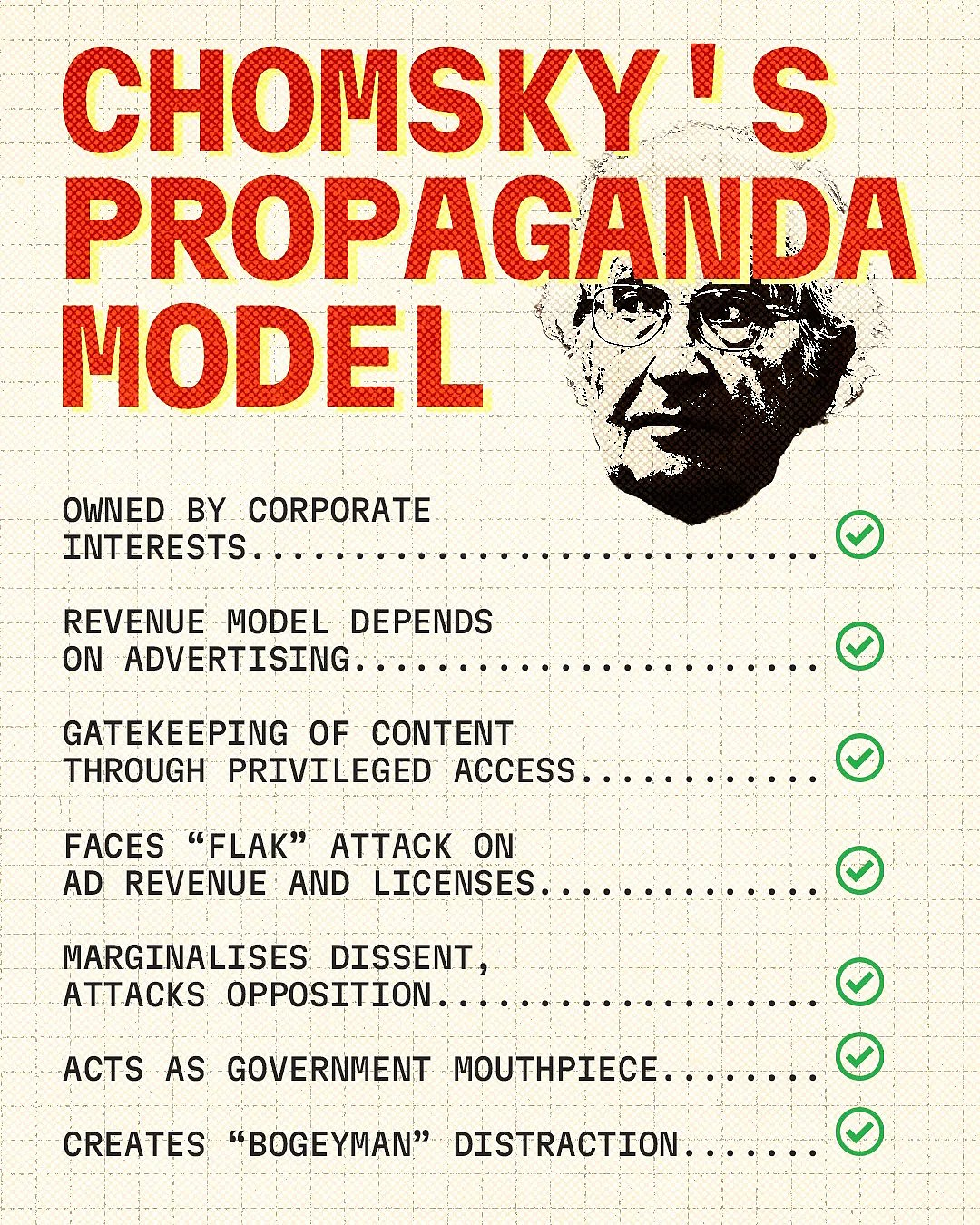
It is striking how lopsided India’s news media is in the sense of acting as the State’s enthusiastic defenders rather than holding the traditional journalistic position of scepticism. This defence of the government flows naturally into an attack on the Opposition.
Recent studies have established that this is a pattern and appears to be deliberate. Such a position is unusual in democracies and this analysis seeks to understand the impulse and motivations behind this phenomenon.
Logically, one would presume that this was because of personal benefit. That the media firms were acting in self-interest. But this is not the case, if benefit and interest means revenue and profits.
Indian media revenue has flattened under Modi
Many of the dominant firms in news media are either listed or large enough (in the case of BCCL) for their revenues to be publicly available. A look at their revenues in the decade from 2014 to 2024 shows some that have grown but the majority that have either plateaued in nominal terms or shrunk.
Here we examine the revenue growth of all of the firms which are in news media and are listed or (in the case of Bennett Coleman and Co Ltd, the publishers of the Times of India) are publicly available. (Note: all revenue numbers are standalone financial figures.)
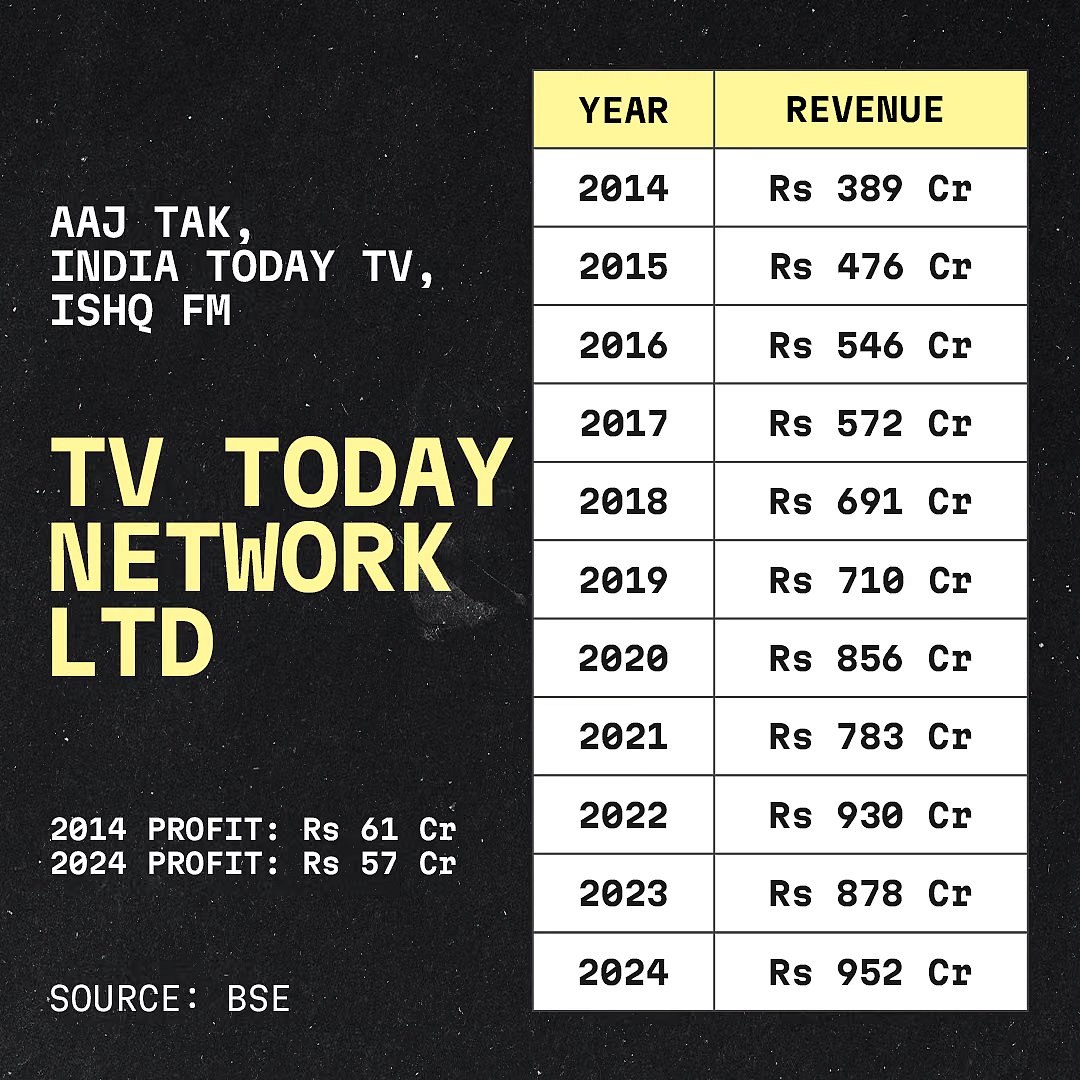
Though the comparison for the purpose of this analysis is a decade between 2014 and 2024, it should be noted that the group’s FY26 revenue was about Rs 808 crore, while net profit fell sharply to around Rs 14 crore.
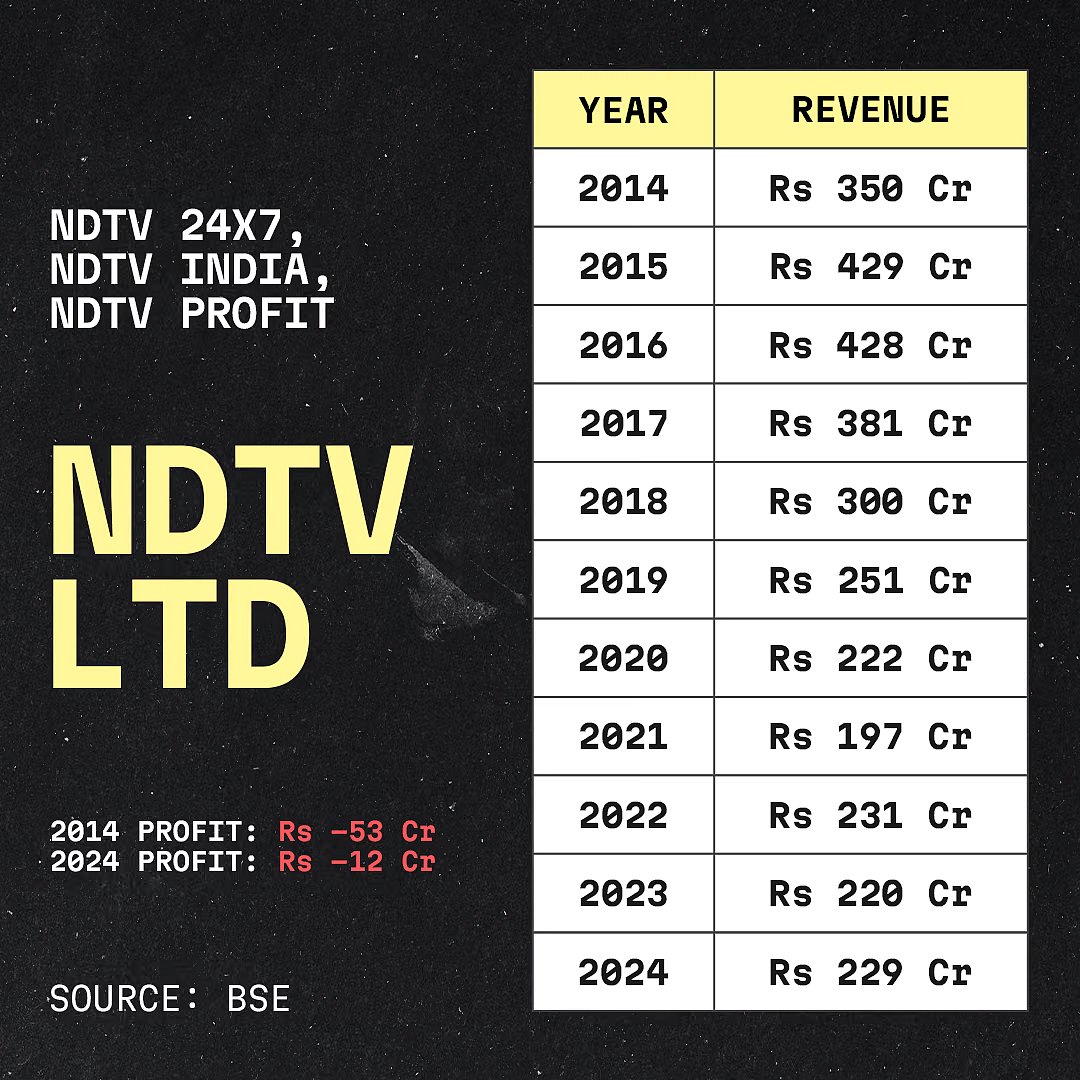
Admittedly, the Adani takeover did not solve the underlying economics. By FY26, the company was generating more revenue than it did in FY24, yet reported losses of over Rs 300 crore.
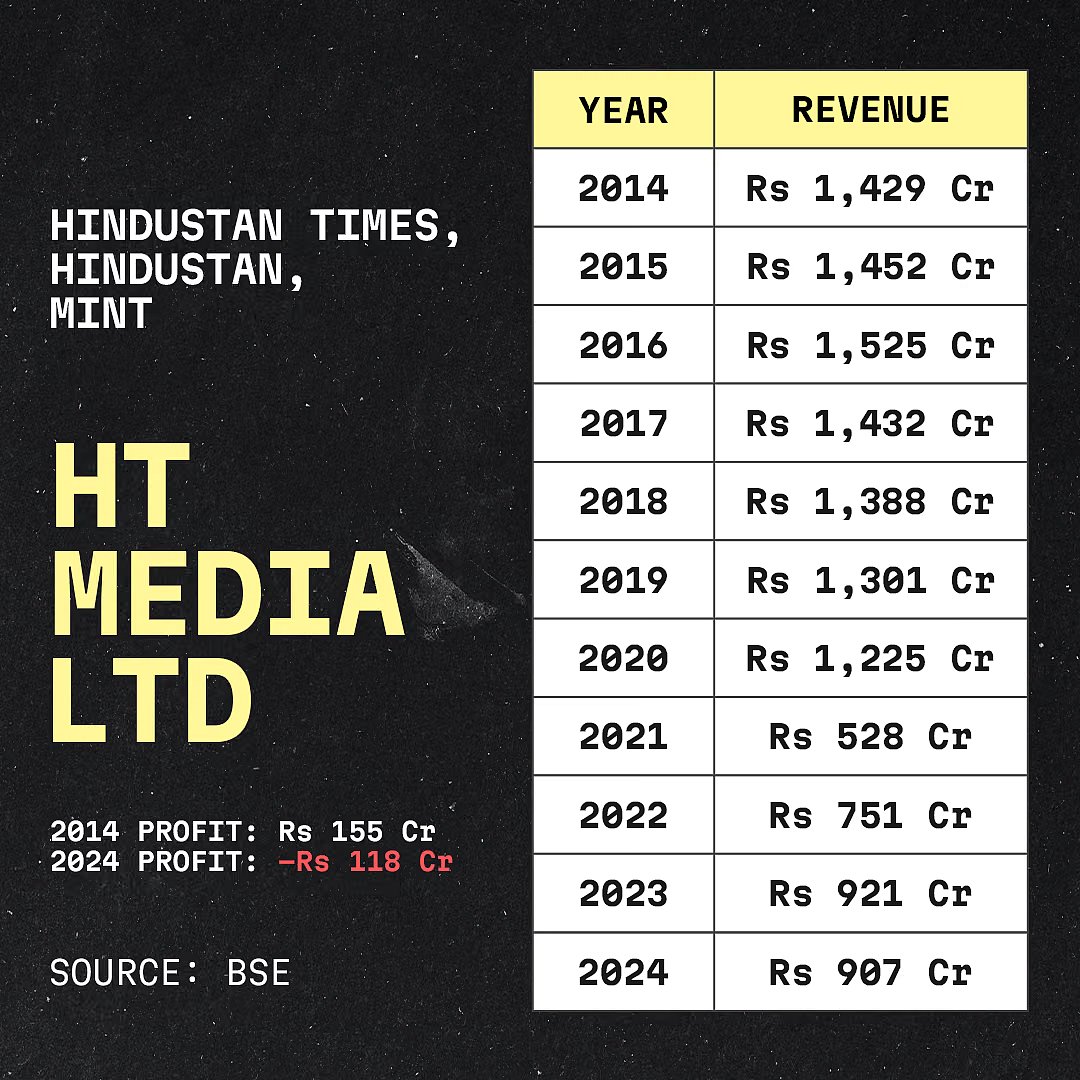
HT Media entered the Modi decade as a profitable newspaper company with revenues of over Rs 1,400 crore and profits of Rs 155 crore. A decade later, revenues had fallen by more than a third and the company was reporting losses of Rs 118 crore.
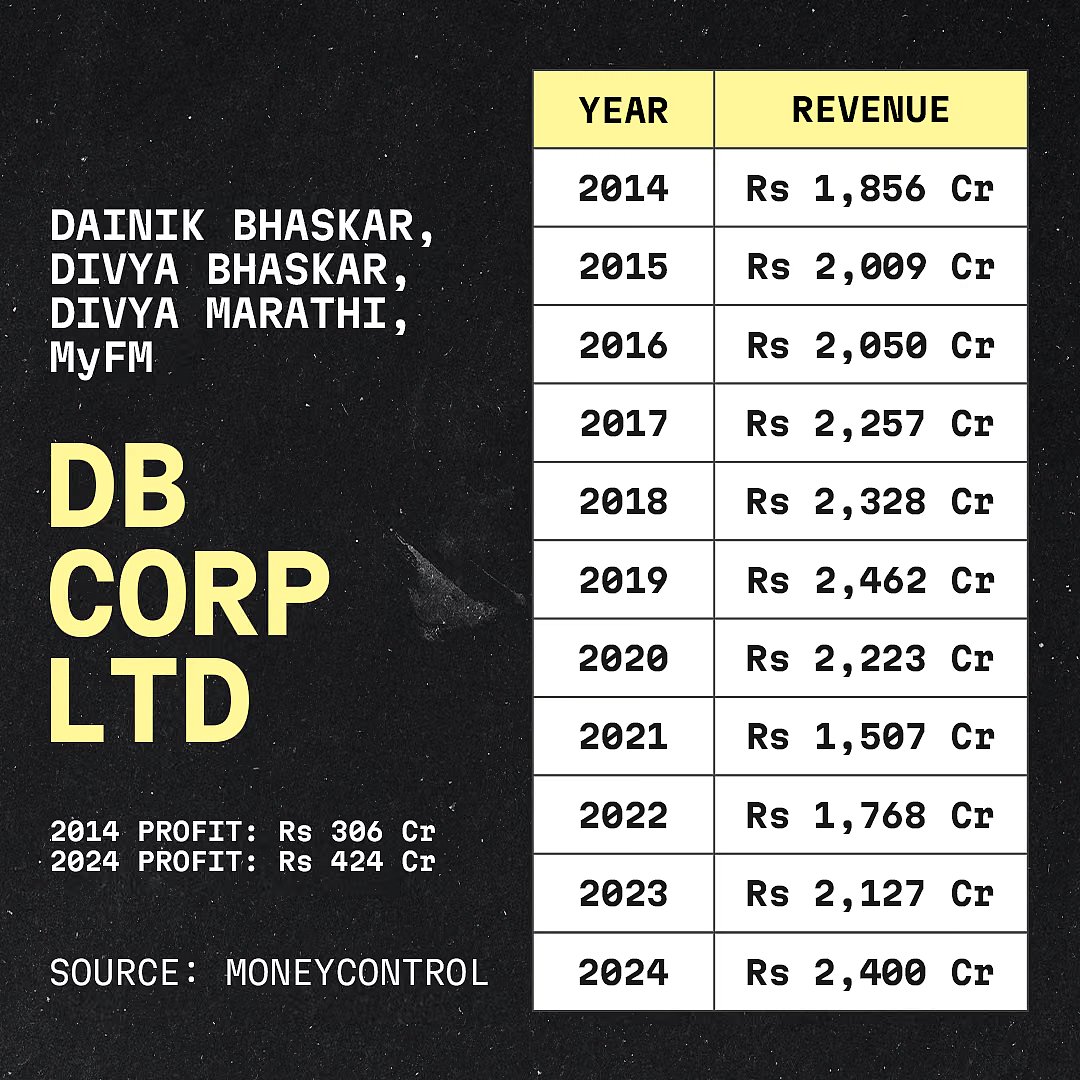
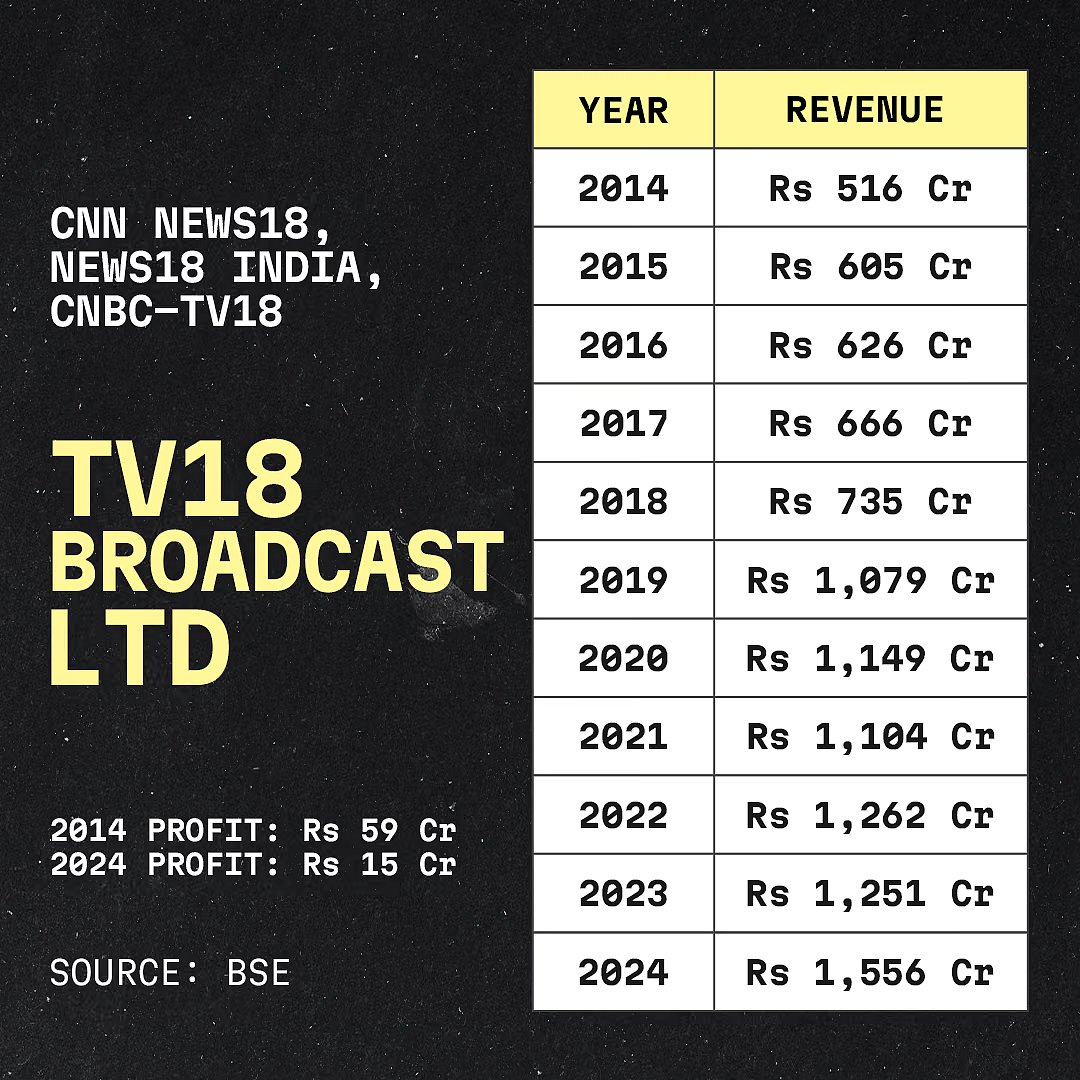
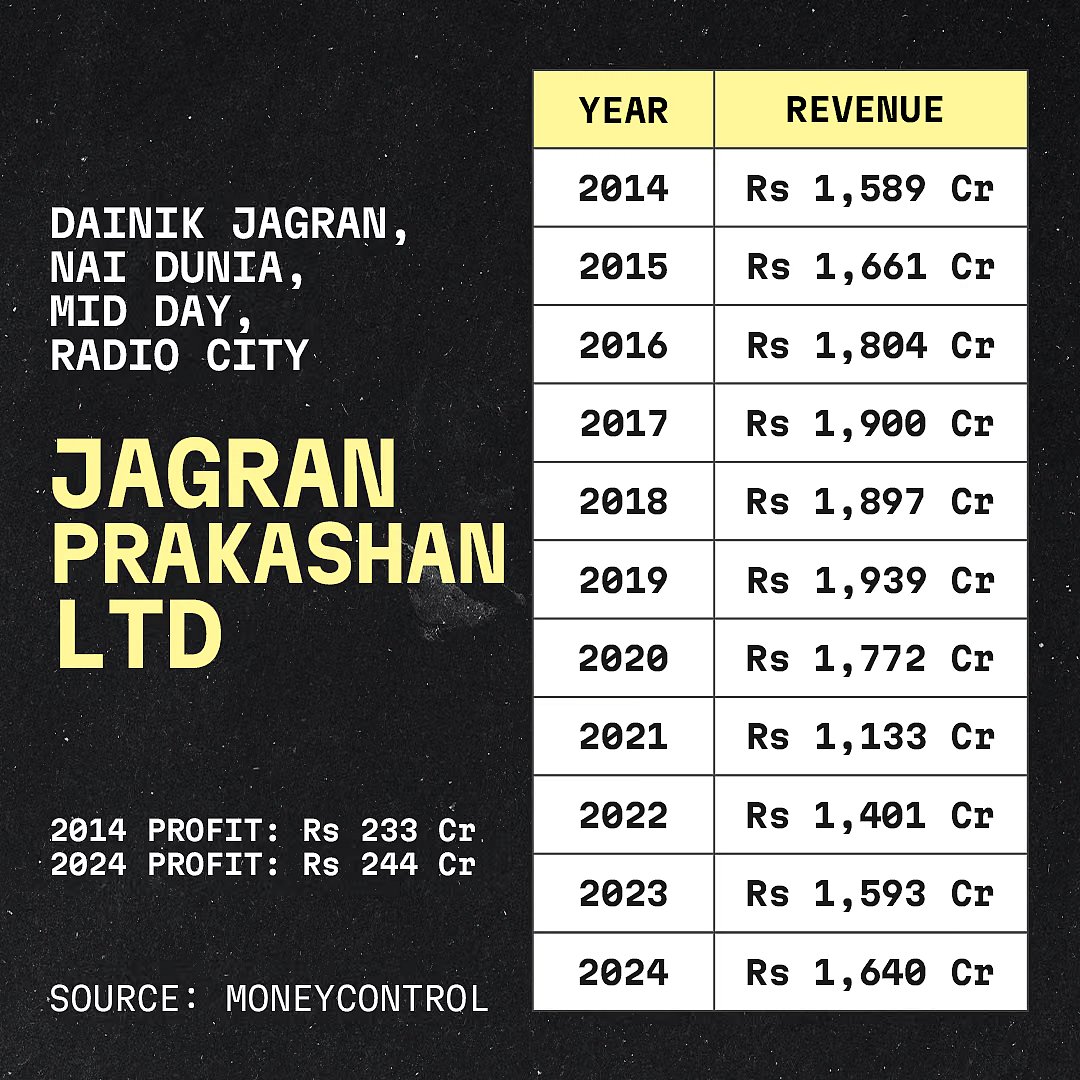
The topline of these six listed news media companies was a total of Rs 6,129 crore in 2014. A decade later, in 2024, the total was Rs 7,684 crore.
The bottomline, or profit, for these six firms in 2014 was a total of Rs 761 crore and this fell in 2024 to Rs 610 crore.
The revenues of these six firms have grown at a compounded annual growth rate of 1.9 percent. If revenues had grown since 2014 at the rate of inflation, meaning not grown at all in real terms, total revenue should still have been Rs 10,000 crore.
What this means then is that these listed media firms actually shrank in the first decade of the Modi era.
For some, profits, for those who still make a profit, are below what they were in 2014. This is not the case for non-media listed companies. Average profits for Nifty 50 companies increased at a compound annual growth rate of 18 percent between FY19 and FY24. So media firms especially were damaged in the first decade of the Modi era.
This makes the question of why Indian media behave in the way they do more interesting. Why does ‘Godi media’ exist at all, when it is apparent that their behaviour is supportive of a State under which they have taken a beating in business terms?
It appears that they have concluded that self-interest lies in submission, and that independence will mean no material benefit and possibly invite further punishment.
Further evidence of decline comes from the biggest news media company in India by revenue. This is Bennett Coleman & Company, which publishes India’s largest-circulated English newspapers in addition to radio stations and news channels including one of the subjects of our analysis, Times Now.
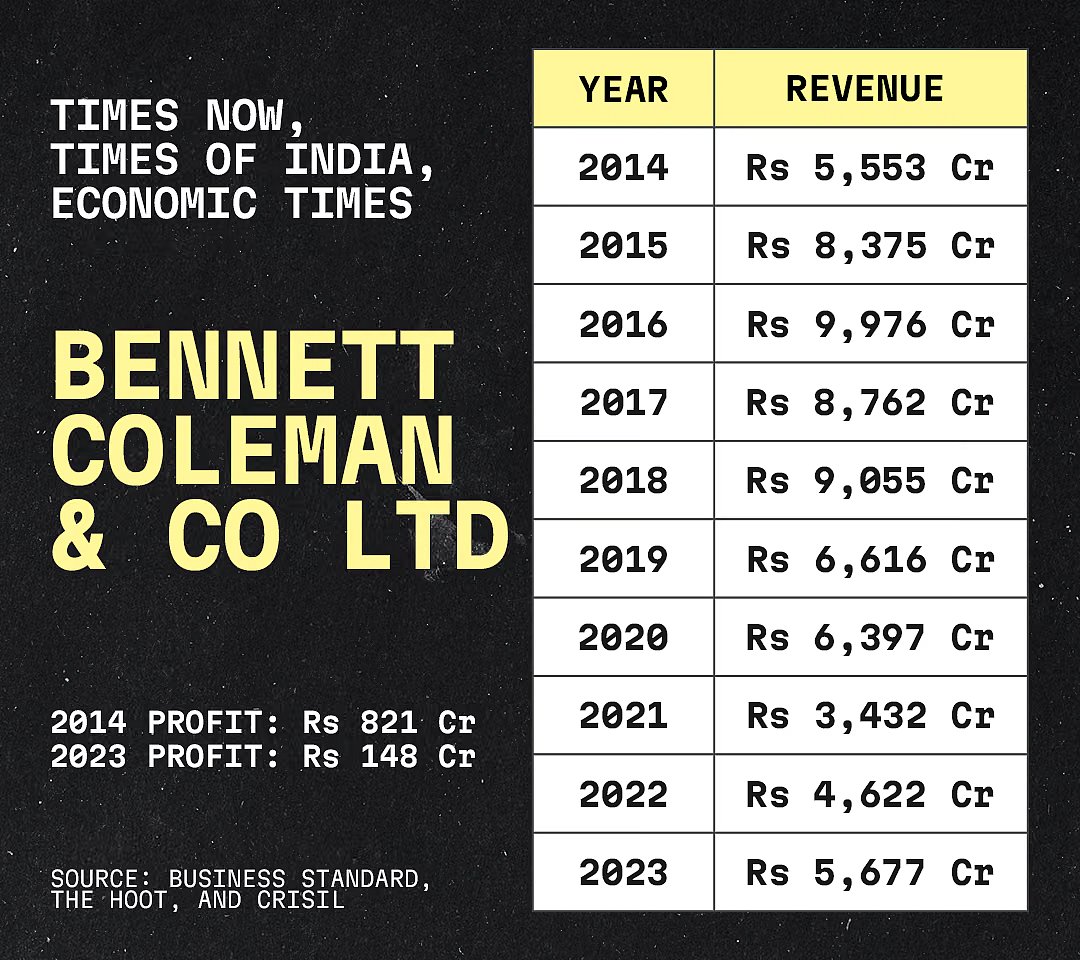
BCCL’s annual profit peaked a decade ago and has been in decline since. From Rs 821 crore in 2014, it rose to Rs 1,186 crore in 2015 and Rs 1,292 crore in 2016, before falling to Rs 219 crore in 2020 and turning negative at Rs -101 crore in 2021. It has since ‘recovered’ post-pandemic to Rs 148 crore in 2023. Note: the group split in 2023
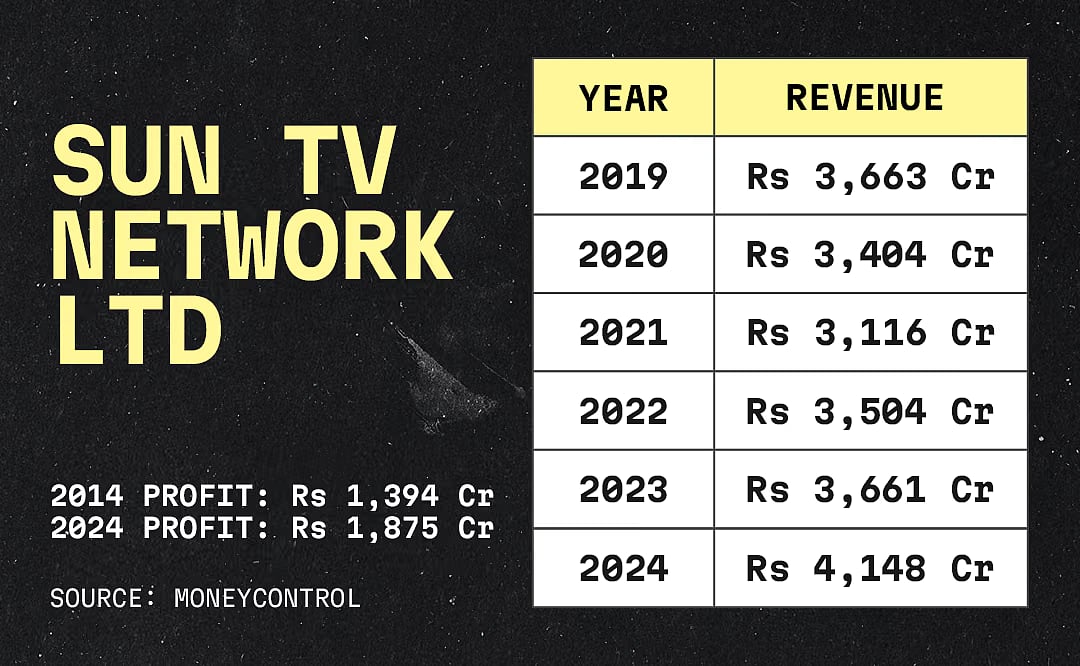
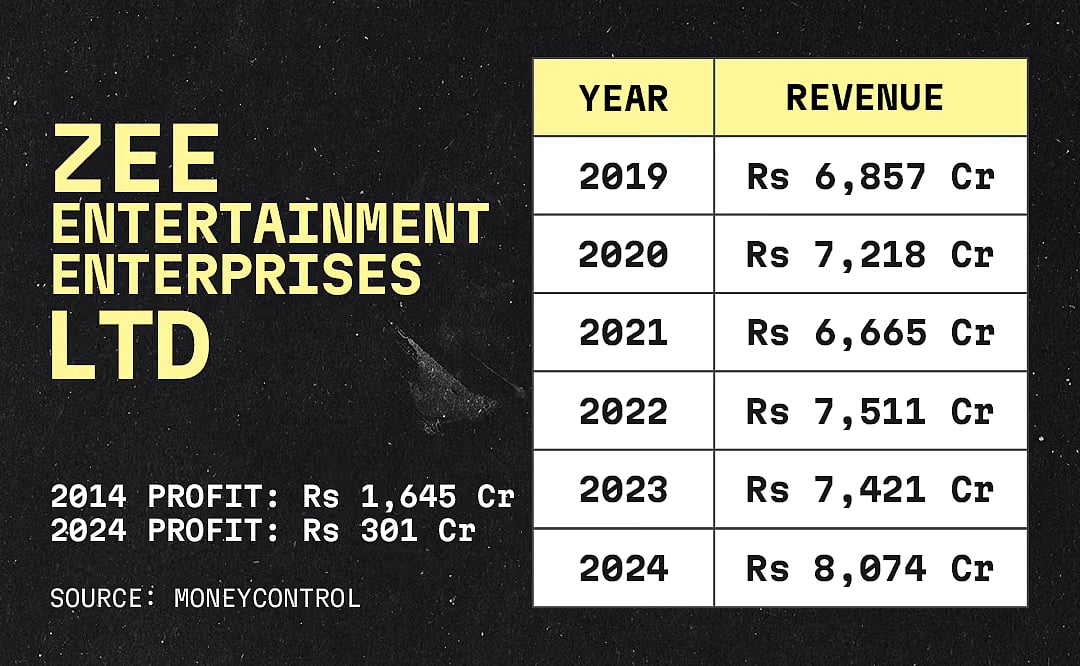
The position in the media industry and its revenues can be compared to the performance of the listed non-news media firms. These have grown in the last five years at about 3 percent. This is the larger problem of the softness in the consumer economy referred to above.
The two largest non-news media firms, one from the south and one from the north, tell a different story:
If not carrot then stick
The largest advertiser in India used to be the Union government through its Directorate of Audio Visual Publicity (DAVP). By 2017, this sum was nearly Rs 1,300 crore, of which the Modi government gave Rs 468 crore to newspapers. This was down from Rs 508 crore in 2016 though DAVP’s budget went up by 8 per cent.
Television channels and digital had got the rest. To put the sum in context, in that year it was more than what was being spent on advertising by all of India’s telecom operators put together. When one sees ads for government campaigns on TV and in newspapers — this is paid for by taxpayer money, of course — it gives the government extraordinary leverage and control over the media.
When the Covid pandemic came, it was apparent that government revenues would suffer because of slowing economic activity. India’s Opposition leader Sonia Gandhi wrote to Prime Minister Modi suggesting that government advertising be cut or put on hold, as an expense that was wasteful. She was saying this both for economic and political reasons, knowing that such spending was a tool to curry favour with the media.
“The government currently spends Rs 1,250 crore per year (not including an equal or greater amount spent by PSUs and government companies),” Gandhi wrote in her letter, “this will free up a substantial amount to alleviate the social and economic impact of Covid-19.”
That meant there was a total of Rs 2,500 crore a year that the government was giving out at its discretion to the media. Covid also brought to a head the crisis the media had been facing, and for the first time the organised media went to the government to say that the industry was in trouble and that it needed help.
After the 2020 lockdown had cut circulation and advertising numbers in half, the Indian Newspaper Society wrote to Modi asking for a “stimulus package” to save India’s print media. The proprietors wanted the government to: increase the spend on newspapers by 200 percent; pay its old dues (the government was not paying media on time), increase the rate DAVP paid them by 50 percent, remove the customs duty on newsprint and give them a two-year tax holiday.
The industry said it had lost around Rs 12,500 crore in the eight months after the lockdown. The same newspapers which had to report on the Modi government and were expected to be critical of it were going to Modi, hat in hand, asking to be saved. It should not surprise us, therefore, that India’s media was unable to perform its essential function in the Modi years.
It is true that this power has been in the hands of all governments of the recent past as Union advertising spends have gone up. But under Modi, the Centre has used the advertising carrot also as a stick. Advertising money was denied to those publications which fell foul of the government for a variety of reasons including being “disrespectful” and for reasons of “inaccurate news reports”. The Modi government actually brought the newspapers to heel.
Not only did Modi disregard the plea of the media industry to increase spending on them and give them some relief, he reduced the money going to them drastically.
The government slashed media spending after Covid with a shift away from mainstream media to more efficient digital media. The share of print went from Rs 636 crore in 2018 to Rs 179 crore in 2022. Television’s share fell from Rs 468 crore to Rs 101 crore in 2022.
The DAVP carrot was thus taken away from the mainstream media by the government and it was accompanied by liberal use of the regulatory and licensing stick. Media that did not conform was punished, and immediately and obviously, as was made clear to proprietors from the start of the Modi era.
A month after demonetisation, on December 6, 2016, Vineet Jain, the managing director of BCCL, which controls the Times Group tweeted:
“Impact of demonetisation-Consumer spend⬇️company/retail sales⬇️real estate⬇️ads⬇️gdp⬇️profits⬇️salary cuts expected⬇️economy⬇️ #NarendraModi”
The removal of currency from circulation abruptly affected the economy negatively and disrupted the lives of the population. What Jain was saying was felt and lived by most Indians.
Eight weeks after that tweet, Modi was to attend the Times Group’s annual business summit as its star attraction but he pulled out, leading to speculation that this was payback for the criticism.
Newslaundry documented 44 instances of the use of Central agencies against the media in five years leading up to 2023. This included 20 from the National Investigation Agency, 15 from the Enforcement Directorate and 9 from the Income Tax department.
After years of harassment, two of India’s most reputable television journalists, Prannoy Roy and Raghav Bahl sold their companies to Gautam Adani. Bahl was raided by the Income Tax department in October 2018. The same month it was reported that he had been denied a licence for television broadcasting because of an absence of security clearance from the Intelligence Bureau. The licence was kept pending by the Modi government till Bahl folded up his TV operation. In June 2019, a money laundering case was filed against him by the Enforcement Directorate. The same year, Adani acquired his company.
Roy was raided by the Central Bureau of Investigation (CBI) in June 2017 and by the Enforcement Directorate (ED) the following month. In June 2020 he and his wife were stopped at the airport from leaving India. In December 2022, Adani acquired his company. In October 2024, the cases were all dropped.
Given the severity with which the Modi government has handled the stick, it is likely that even while suffering economically, media owners felt it was in their self-interest to keep acting as Godi media if they were not to face trouble.
Being seen as independent could even get them into trouble elsewhere. Media that was challenging the government was perceived to be acting against the national interest.
A network head said that a regular advertiser, a German maker of luxury cars, sent a letter to him saying advertising was being discontinued. This was because, and the letter sent by the head of marketing used this phrase, the channel was “anti-national”. The network forwarded the letter to the auto company’s German CEO, who apologised and said this had been sent in error. Advertising however did not resume.
Industry voices
To better understand the nature of the media’s relationship with the government, the author sent a set of questions to individuals who were either chief executives/chairmen of media firms or their editors in chief. The questions were:
Q1. What, if any, incentives are there for channels to back the government and attack the opposition?
Q2. To what extent are news channel operations dependent on advertising (and other favours) from the government?
Q3. Do ratings generally indicate audience preference for content that is communally polarising over that which might be conventional news?
Q4. Do ratings indicate audience preference for journalism that bolsters and justifies the government?
On the first question, the respondents agreed that there was “a desire to be on the right side of government”. This was the case especially because they were dealing with a government that saw the world in black and white terms, where the media was either for it or against it. And they recognised that this was a government capable of and willing to use or misuse the law against them.
There was also the idea, one of them said, of being “lured by proximity”, meaning the desire to be close to power for the sake of it. Having the prime minister and his senior cabinet colleagues at their events was desirable.
However, this proximity had come with no real advantage in terms of media output, as more than one of them pointed out. Apart from his reticence to hold press conferences, the prime minister has also functioned with a level of opacity and unpredictability that is unusual in democracies. Two emblematic instances cited were the national lockdown of 2020 and demonetisation, which came without warning not just to the media but also the Union Cabinet.
On the other hand, as one respondent put it, there were “no briefings to journalists save for a few and so access (was) important”. Meaning that if a media entity held a neutral position and did not show softness, it was in danger of being cut off from even the meagre dribble of information that was flowing out.
On the second question, concerning the role of advertising money from the government, all respondents were familiar with the position. The view of one editor was that the weakness of the media economy was tied to the media’s supplication. “If there were ways to make money, the media would find a way to do so with a taller spine,” was how this individual put it. Surrendering to the government had meant that many media outlets had closed off even the idea that questioning it might lead to wider circulation or increased viewership.
To the question of the use of the stick, one said that “political pressure is not the number one cause, it is the broken revenue model”. Meaning that if the mass media had some way of making money it was more likely to stand up to the State. This was because “revenue from [the] government has become dependent to [a] large extent given the falling revenues overall”. One individual said that the “struggle with bottom lines had moved from the corporate office to the newsroom” and that journalists were “aware that their work could not sharply differ from the proprietor’s interests”. This, in turn, meant that it was perhaps no longer needed to even pressure journalists to not report material the government would take a dislike to.
The absence of journalist-proprietors in the industry was also being felt as there were now “no more Bahl, Roy sort of professionals owning media but corporations which need government for other things”. There are of course journalist-owned entities that exist, but none of this scale and none in the mass media of television and newspapers.
To the third and fourth questions, the view was that there was little evidence to suggest that divisive material ran well generally compared to other stories, and that ratings did not return numbers that indicated this. However, material that was polarising did not lead to dip in viewership, meaning that it was not off-putting.
On the other hand, what was in the news at the moment received ‘pick-up’ when it was broadcast as hate speech. The example given by this individual was about when the government associated Muslims with the Covid-19 pandemic, it triggered a slew of coverage that alleged Muslims were deliberately spreading the Coronavirus, and that this coverage did not suffer in terms of ratings.
Overt majoritarianism under Modi has produced a condition where “existent bigotry is given a platform to be amplified” in newsrooms, one said. The prejudice was “bigotry normalised… a few years ago phrases like love jihad would not be used as being factual” in news reports, as has now become commonplace.
There seemed to be little evidence to show that supporting the government and attacking the Opposition produced higher viewership or was popular, so there was another motive for doing so and that was corporate interest.
In addition, especially in the English news channel space, there emerged something called the “Arnab phenomenon” which was described as “populism” and “news as theatre”, whose core was a defence of the government and an attack on the Opposition.
Why they do what they do
The Godi media phenomenon exists for two sets of reasons. The first is transient. A stagnant media economy has made media hostage to government largesse. In the first term of the Modi government this money flowed at levels it had not done before and it was in the interest of the media owners to keep this flow going.
The flattening of consumption expenditure and its fallout on advertising hit the media directly but paradoxically made it even more dependent on the government. This has made it reluctant to play its traditional role.
The government’s enthusiasm for wielding Central agencies against media outlets it disliked provided a cue to the rest to fall in line. Both of these factors can shift, assuming the next government were to alter its position and the economy were to turn around on the consumption side.
The structural factor for the phenomenon is the shift in the patterns of ownership. For Adani and Ambani, the media is a minuscule part of their business interests. NDTV Ltd’s turnover of Rs 228 crore in 2024 is 0.07 percent of the Adani Group’s turnover. TV18 Broadcast Ltd’s turnover of Rs 1,556 crore is 0.15 percent of the Reliance Group’s turnover. The media holdings are not businesses that are material to the group in the economic sense; they serve another purpose and for that reason will not change even if the government does. If not acting as the Godi of one government they will act as that of another.
The global patterns of shrinking of the news media space, in print for certain but also in news television, has affected India. All of the above also offers an explanation to the refreshing rise of independent media as a material force in India under Modi.
Every complaint about Godi media eventually runs into the same question: who pays for the news? If readers don't, someone else will. And whoever pays the bills gets a say in what remains unsaid. Support independent journalism. And if this story mattered to you, persuade one more person to subscribe too.