
“Do you see those apartments? That is where our lands used to be,” Krishnamurthy, a resident of Attibele in Bengaluru, said. Growing up in a landless Dalit family, he heard stories about how once his family had owned some land in the village, which was sold off for a petty amount. But nobody in his family knew where those lands were. This was Krishnamurthy’s primary motivation in joining a prominent Dalit organisation, founded by a leader from his own village.
After hundreds of visits to the local tehsildar office, he discovered that his grandfather was granted 3 acres of land in 1951 with the condition that the land could never be alienated. But in 1958, the land was sold to a Lingayat landlord of the village. Since then, the land was transacted many times, eventually being bought by a developer who erected residential apartments on it. The land was worth a fortune today, if only Krishnamurthy could get it back.
This is where the Karnataka Scheduled Castes and Scheduled Tribes (Prohibition of Transfer of Certain Lands) Act, 1978 (PTCL Act, 1978) came in. This special legislation was enacted to come to the aid of landless families like Krishnamurthy’s, allowing them to reclaim their lands which were alienated in violation of any of the conditions attached to the grant.
But there was a problem. The Supreme Court of India had delivered a judgement in Nekkanti Rama Lakshmi vs State of Karnataka (2017), which held that applications for restitution of lands under the PTCL Act, 1978 should be filed without “unreasonable delay”. By the time Krishnamurthy could collect all the necessary documents, 40 years had elapsed since the enactment of this legislation, and he feared that his application would be dismissed on grounds of “unreasonable delay” as had happened to hundreds of others like him, who had become aware about this legislation only recently.
For this reason, he was mobilising youths like himself to participate in the indefinite protests at Freedom Park in Bengaluru, when we met him in November 2022. Several Dalit organisations, including his own, were demanding that the government pass an amendment to overcome the difficulties created by the Supreme Court verdict.
Eventually, these protests lasted for 208 days (7 months), and while the outgoing BJP government did not heed the demands, the Congress included them in their 10-point poll promises for the Dalit community in the state. When the Siddaramaiah-led Congress government came to power in Karnataka in 2023, one of the first legislative steps it took was to bring an amendment to the PTCL Act, 1978, raising hopes among those like Krishnamurthy that they can now get their lands back.
But these hopes have been belied. Dalit organisations have resumed their protest on April 30, with a charter of 15 demands. To understand why such a protest became necessary despite the 2023 amendment, one has to look back at the sordid history of how the hostility of the revenue bureaucracy and apathy of the judiciary towards the objectives of this special legislation has almost entirely hollowed it out.
Historical sources of land ownership for Dalits in Karnataka
Broadly, there are three sources through which any person can come to own a piece of land – inheritance, purchase, and grant by the government. Historically, the first two channels were closed to Dalits because of the operation of custom, economics, and statutory law, undergirded by their location in the caste system, as noted by Dr BR Ambedkar in Untouchables or the Children of India’s Ghetto (BAWS, Vol 5, p 23):
In an agrarian country, farming can be the main source of living. But this source of earning a living is generally not open to the Untouchables. This is so for a variety of reasons. In the first place, purchase of land is beyond their means. Secondly, even if an Untouchable has the money to purchase land s/he has no opportunity to do so. In most parts, the caste Hindus would resent an Untouchable coming forward to purchase land and thereby trying to become the equal of the so-called ‘Touchable’ class of Hindus. Such an act of courage on the part of an Untouchable would be seen as a provocation for harsh collective punishment. An entire community could be targeted for an individual’s transgression.
In some parts, Dalits are disabled by law from purchasing land. For instance, in the Province of Punjab there is a law called the Land Alienation Act. This law specifies the communities which can purchase land and the Untouchables are excluded from the list. The result is that in most part the Untouchables are forced to be landless labourers.
The reference here is to the Punjab Agricultural Land Alienation Act, 1901 which classified communities into agricultural and non-agricultural, and prohibited acquisition of land by the later sets of communities. Two of the most populous Dalit communities were included in the non-agricultural category, prohibiting transfer of lands to them.
While the Dalits were not statutorily prohibited from purchasing land in the Princely State of Mysore, other caste-derived disabilities operated to ensure that here too, they were largely landless labourers. The 1931 Census, considered to be the most comprehensive, showed that while the Depressed Classes comprised only 15% of the population of the state, their share in agricultural labourers was over 36%. Of all the members of Depressed Classes deriving income from agriculture, over 46% were agricultural labourers, while just over 8% were tenant cultivators.
Historically, there were two major sources of land ownership among Dalits in the Princely State of Mysore – grants of lands referred to as darkhast lands and gift of lands in lieu of services referred to as inams. The rulers of Mysore took several positive measures in the first half of the 20th century to grant lands to landless members of Depressed Classes either free or at discounted rates.
The inams were given to individuals for services rendered to the state (called personal inams) and for services rendered to the village (called village service inams). The village service inams were attached to village offices like neerganti, patil, kulkarni, etc. Members of the Depressed Classes were employed largely as thoti/taliari, which required them to dispose of dead animals, play drums at village and temple festivals, and make various kinds of announcements in the village. In lieu of these services, they were given lands. These were customary and hereditary offices, whose origin is traced back to the Vijayanagara Empire. In character, these were very similar to the maharwatan lands in Bombay Presidency, where such customary titles were given statutory basis under the Bombay Hereditary Offices Act, 1874.
Dr Ambedkar had introduced a Bill in the Bombay Legislative Assembly to abolish maharwatans because the title-holder and their family could be called for performing all and sundry work by the village and the administration.
After Independence, the State of Mysore abolished these village offices, although in many areas the thoti practice continues. Those working as thoti/taliari were allowed to get the lands attached to these village offices regranted to them. Personal inams were also abolished in the 1950s, after allowing the inam-holder to retain portions of lands for personal cultivation, while the rest of the lands were taken over by the state and distributed to tenants cultivating those lands.
Post-Independence source of land for Dalits in Karnataka
Apart from these historical sources, lands were also granted to members of Scheduled Castes and Scheduled Tribes under various post-Independence laws. The Karnataka Land Reform Act, 1961, which was strengthened in 1974 during the Devaraj Urs period, allowed tenants to obtain lands through Land Tribunals.
Although some Dalit families did receive lands under these tenancy abolition provisions, the extent was not very large, owing to the uneven implementation of the provisions, but also because tenancy was not very common among Dalits, who were largely agricultural workers.
The surplus lands (above the land ceilings) were to be taken over by the state and added to the common pool of land available for distribution. Under the Karnataka Land Grant Rules, 1969, among the lands distributed by the government every year, 50% were to be given to members of Scheduled Castes and Scheduled Tribes. Although several parcels of lands were granted to SCs and STs during the 1960s and 1970s, the proportion of such grants was nowhere close to the 50% mandate above, largely because the lower bureaucracy remained a stronghold of the Brahmins and the dominant landed castes.
With the adoption of neo-liberal policies in India in the 1990s, the land policy underwent a paradigm shift. In a bid to attract investments in industries, successive state governments started acquiring lands for land banks. Influx of global capital led to speculation in land markets, pushing up land prices. Distribution of government lands to landless families dropped in priority, far behind industrial use and real estate, and grant of lands turned into a trickle.
From the 1990s onwards, the primary source of obtaining government land was the regularisation of unauthorised cultivation, referred to as bagair hukum (literally, without authorisation). While members of SC and ST communities could obtain some lands under bagair hukum regularisation, the major beneficiaries were the dominant castes. Finally, recognising the role that land ownership could play in social and economic empowerment of Dalits, various development corporations functioning under the Social Welfare Department have been implementing Land Purchase schemes, which provide financial assistance for purchasing lands at market rates.
Loss of lands and the PTCL Act, 1978
Almost immediately after the advent of the policy of grant of lands to Depressed Classes at concessional rates under the Princely State of Mysore, it was observed that the granted lands were being sold at throwaway prices, often because of either economic compulsion, or coercion or fraud. Hence, the administration imposed conditions that these lands could not be alienated for a period of time, which was specified as 10 years in the beginning, then increased to 20 years in 1932, and a complete prohibition on alienation was imposed from 1938. The post-Independence state also laid down similar conditions while granting lands to SCs and STs.
But these conditions proved ineffective in preventing such forced alienations, as was the case with Krishnamurthy’s grandfather.
In 1976, the Dalit Sangharsha Samithi undertook a protest demanding restoration of land to a Dalit family in Siddlipura village in Bhadravathi taluka, Shivamogga district, who had been deprived of their land in violation of the grant conditions. In the course of this protest, which lasted for over 18 months, the demand for a special legislation to protect lands granted to SCs and STs emerged. The then Revenue Minister, B Basavalingappa, piloted a Bill which became the PTCL Act, 1978, and came into force on January 1, 1979 after receiving presidential assent.
It is a relatively short legislation with 12 sections. Any alienation of ‘granted lands’ in contravention of the grant conditions or the law under which the grant is made, both before and after the commencement of the Act is declared to be null and void. Further, after the Act comes into force, any alienation, even if in accordance with grant conditions and the concerned provisions, has to be with prior permission of the government. In case of a void transfer, an application for restoration of alienated land can be filed before the Assistant Commissioner by any interested person, or any person having relevant information or even on a suo motu basis. The Act makes acquisition of land in contravention of its provisions a cognisable offence.
A recent study conducted by the Alternative Law Forum across Chikkamgaluru, Tumkuru, and Raichuru showed that across 25 villages in these three districts, inam lands constituted one-third of all the lands lost by SC and ST households in the sample (N=1123).
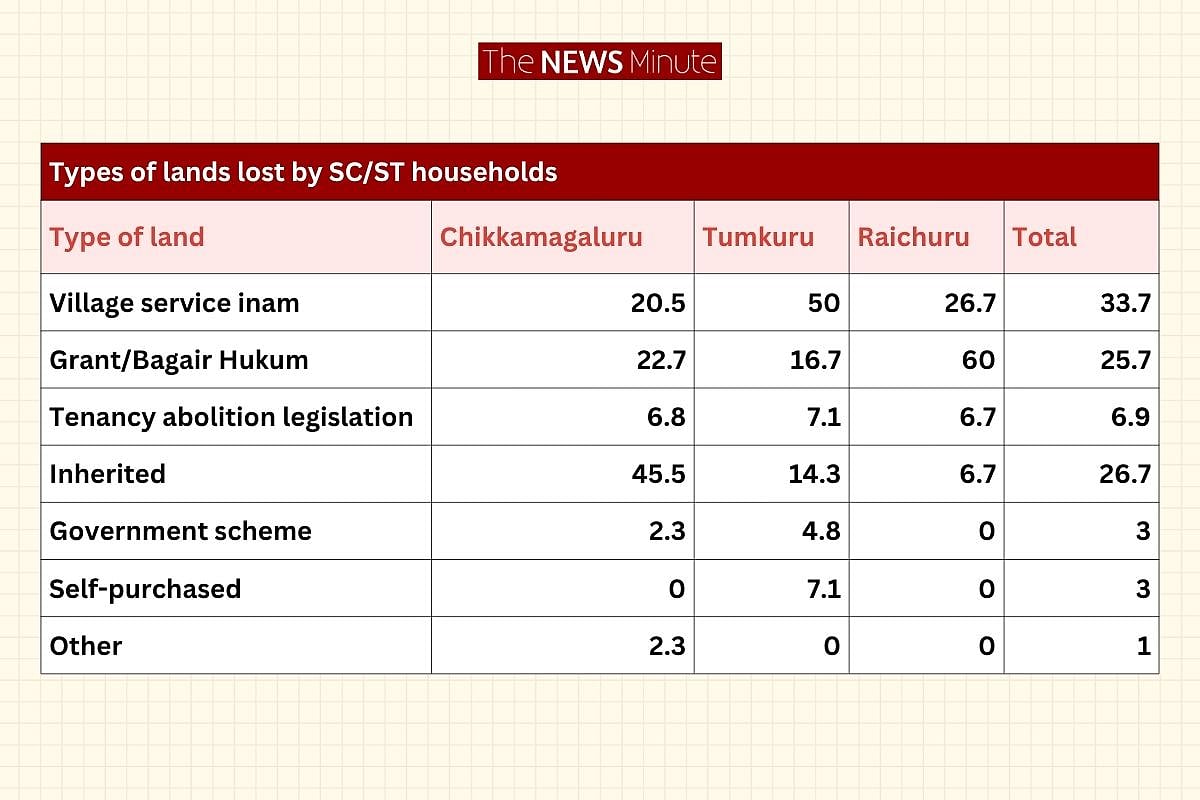
Under the Act, ‘granted lands’ to which protection has been extended, are defined as:
‘any lands granted by the Government to a person belonging to any of the Scheduled Castes or the Scheduled Tribes and includes land allotted or granted to such person under the relevant law for the time being in force relating to agrarian reforms or land ceilings or abolition of inams, other than that relating to hereditary offices or rights.’
The village service inams have been excluded from protection under the Act, which has likely resulted in loss of these kinds of lands. That’s why several Dalit organisations have long demanded that these lands should also be brought under the Act. But other categories of land that would appear to be protected under the Act, from a plain reading of the above definition, have been progressively excluded from the purview of the Act through judicial decisions.
The PTCL Act, 1978 and the judiciary
The legislation was challenged immediately after its enactment, but it was upheld by both the Karnataka High Court and the the Supreme Court of India. During the course of the challenge before the Supreme Court, in Manchegowda and Ors. Vs. State of Karnataka and Ors., a provision for appeal before the Deputy Commissioner was added, which was not there in the original legislation.
The judicial hollowing out of the legislation began in the 2000s. The timing is significant for two reasons. Firstly, while the legislation had been on the statute since 1978, cases for restoration under the Act began to be filed only in the 2000s, with the advance of general education and legal awareness among SCs and STs. Secondly, with the post-liberalisation jump in land prices, the economic stakes involved in these cases became quite high. In Bengaluru, for example, in many instances the protected lands had changed several times, and had entered the real estate market by the time they were sought to be restored.
In Mohammed Jaffar And Anr. vs State Of Karnataka And Ors (2002), the Karnataka High Court ruled that lands obtained under the tenancy abolition provisions did not fall within the ambit of granted lands under the Act. In Kumari vs Deputy Commissioner, Shivamogga (2025), the Karnataka High Court ruled that lands regularised under Bagair Hukum would not attract protection under the Act. These judgements left only lands granted under the Grant/Darkhast rules with protection under the Act.
The biggest blow was dealt by the judgement of Supreme Court in Nekkanti Rama Lakshmi vs State of Karnataka (2017), where the Court held that even when the legislation did not impose any time limitation on when an application could be filed, the provisions of the Act should be invoked in a reasonable time period. In this instance, the application was filed 25 years after the legislation came into force, which was held to be an unreasonable delay. The state government did not appeal, and the revenue courts started dismissing applications citing this judgement. It was in the background of this development that the 7-month long day-and-night protests were organised.
In 2023, the newly elected Congress government passed an amendment and added a non-obstance clause stating ‘notwithstanding anything contained in any law, there shall be no limitation of time to invoke the provisions of this Act’, but this was made applicable only to pending and future cases, excluding those hundreds of cases that were dismissed between 2017 and 2023 based on the Nekkanti Rama Lakshmi judgement.
This amendment inaugurated another round of legal battle in courts, resulting in several adverse judgements. While a constitutional challenge to the amendment was pending before one bench of the High Court, another bench delivered a judgement in Gouramma @ Gangamma vs Deputy Commissioner Haveri (2024), stating that the amendment, even if valid, speaks only of ‘limitation’ while the Supreme Court judgement in Nekkanti Rama Lakshmi had found fault with ‘unreasonable delay’ based on doctrine of latches. It held that the amendment, even if valid, would not overcome the ruling in Nekkanti Rama Lakshmi, and applications could still be dismissed if there was unreasonable delay. In M Manjula vs Deputy Commissioner, Bengaluru (2024), a division bench of the High Court spoke of the judgement in Gouramma @ Gangamma vs Deputy Commissioner Haveri in approving terms, and decided against heirs of original grantee based on ‘unreasonable delay’ of 12 years.
Thus, through these decisions, the judiciary has reduced the scope of the PTCL Act 1978 to only darkhast/grant lands that were alienated not earlier than 12 years back, limiting the protection provided by the legislation to only a handful of instances.
Consequently, one of the key demands of the ongoing protest is that all lands that have been granted by the government to SCs and STs, of whatever description, should be included under the Act.
Complicity of revenue administration
The revenue administration has not been far behind in rendering this legislation ineffective. Section 6 of the PTCL Act, 1978 prohibits registering officers from registering any transaction on lands falling under the PTCL Act. But such transactions have been registered unscrupulously at the sub-registrar offices.
An analysis of time taken by Assistant Commissioner and Deputy Commissioner courts in Tumkuru and Chikkamagaluru to dispose of applications and appeals shows that 52% of the cases take over 5 years. Of the 883 cases analysed across these two districts, not a single case was filed suo motu. Additionally, in the last 15 years for which data is available, only 5 criminal cases have been filed under the Act, none of them leading to a conviction.
The study conducted by Alternative Law Forum records the close relationship between land ownership among Dalits and their ability to collectively challenge untouchability practices and caste discrimination in their villages. While other sources of power have emerged in rural Karnataka, land still forms a key basis of power, and so the importance of addressing landlessness cannot be emphasised enough.
The PTCL Act has been the only bulwark against rendering small and marginal landholders landless among the Dalit communities in Karnataka. If urgent action is not taken by the state government to address the concerns of the ongoing agitations, this landmark legislation would soon become a dead letter.
Siddharth K Joshi is an independent researcher and the author of the Report on Implementation of Laws for Welfare of Scheduled Castes and Scheduled Tribes in Karnataka (2026) based on a study by the Alternative Law Forum, Bengaluru.