
Women account for nearly 60 per cent of all cancer patients treated under the Rajiv Aarogyasri Healthcare Scheme in Telangana, with palliative care emerging as the most common treatment option — a pattern that points to delayed diagnosis and limited access to early screening, according to a Cancer Incidence and Prevalence Mapping report released by the Rajiv Aarogyasri Healthcare Trust.
The report, which covers data from April 2020 to September 2025, identified 1,00,294 cancer patients under the scheme. Of these, 59,994 were women and 40,300 were men. The cancer incidence rate among women stood at approximately 62 cases per one lakh population annually, compared to 42 per one lakh among men.
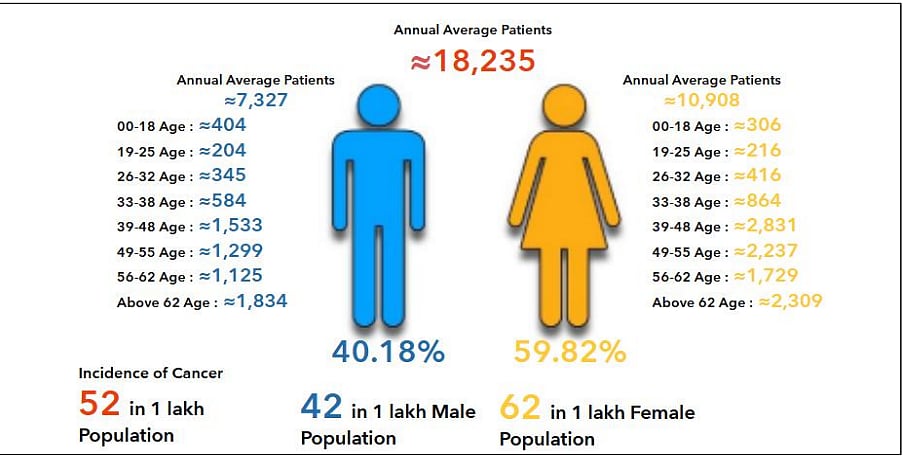
The high dependence on palliative care by women (19,559 patients) make it the largest single treatment option among women. This indicates that a significant share of female patients are reaching the healthcare system only at advanced stages of the disease.
Breast cancer treatment accounted for 15,502 patients, while cervical cancer treatment accounted for 11,834 cases. Ovarian cancer treatments also formed a significant share of female oncology care. Both breast and cervical cancers are largely treatable when detected early, making the late-stage burden in the data a public health concern.
Across adult age groups above 33 years, female patients consistently outnumbered males, with the sharpest gap in the 39–48 age group, where female patients were nearly double the number of male patients.
The Rajiv Aarogyasri Healthcare Scheme provides comprehensive cashless healthcare services to Below Poverty Line households and food security cardholders through a network of government and private hospitals. Over the past five years, the scheme has treated over 14.9 lakh patients, with cancer emerging as the second most treated condition after kidney ailments, accounting for 4,96,552 cases. The annual treatment limit is set at Rs 10 lakh per family, covering 1,835 procedures including 163 advanced treatments and follow-up packages.
Despite government hospitals accounting for 66.7 per cent of Aarogyasri-empanelled cancer care facilities, private hospitals treated a larger share of patients — 53,523 against 43,480 in government hospitals during the study period. Around 3,291 patients received treatment in both. The difference is more pronounced in specialised care: in radiation oncology, nearly 64.9 per cent of patients were treated in private hospitals compared to 34.1 per cent in government facilities, indicating a concentration of advanced radiotherapy infrastructure in the private sector. Surgical oncology and medical oncology also recorded higher patient numbers in private hospitals.
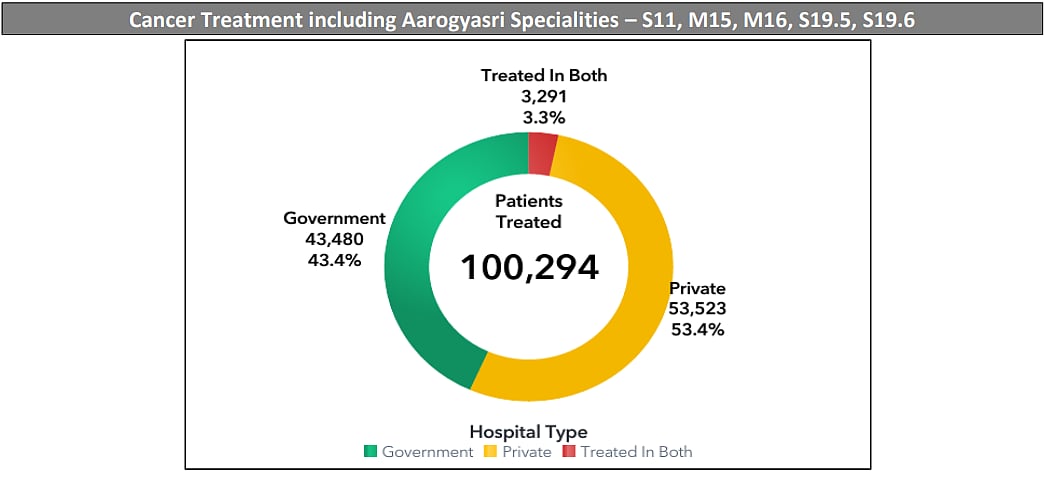
The report suggests that the preference for private hospitals may be linked to better availability of specialised equipment, shorter waiting periods, and the concentration of oncology services in urban centres, particularly Hyderabad. Hyderabad alone accounted for 12,517 cancer patients treated under Aarogyasri, followed by Rangareddy with 6,372 and Medchal with 5,483 patients.
While Hyderabad recorded the highest patient numbers, Hanamkonda district reported the highest cancer incidence rate in the state at 79 cases per one lakh population annually, followed by Hyderabad at 72 and Karimnagar at 65. The report noted that 25 of Telangana's 33 districts recorded incidence rates above 45 cases per lakh population.
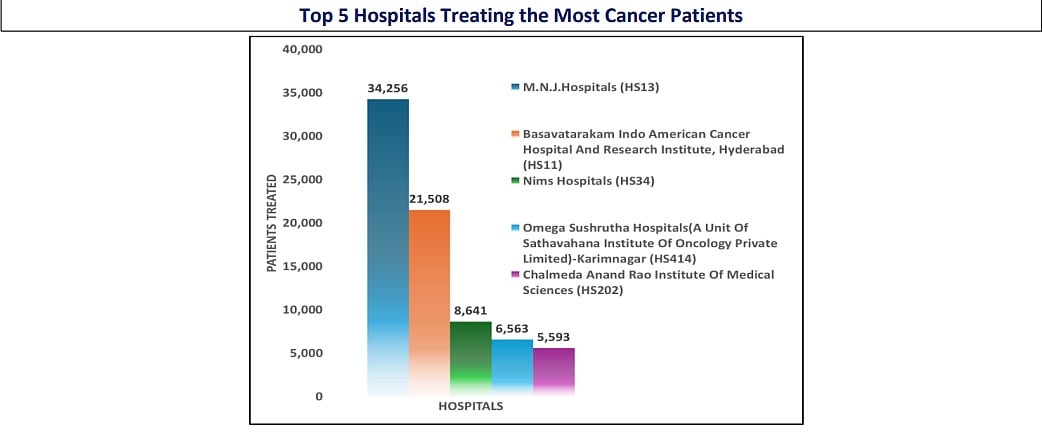
The report also highlighted that cancer treatment under Aarogyasri remains highly centralised, with a small number of hospitals handling a majority of patient cases. Among all hospitals, MNJ Hospital emerged as the largest cancer care hub in the state, treating significantly higher patient volumes than any other institution in the Aarogyasri network.
Source: Report of Cancer Incidence and Prevalence Mapping across Telangana
(This story was written by a student interning with TNM.)
Propaganda is free and the truth needs your money to survive. Subscribe to TNM and pay to keep news free.